

A ChartMogul alternative built for agents, not just dashboards
Kometrics was built for the AI era: your revenue inside Claude, ChatGPT, Claude Code and Codex over MCP, an AI that reads your live book, and a ledger every answer can be traced back to. How it compares to ChartMogul, and how to switch.
By Pedro Campos

ChartMogul is a good product. They have been modeling subscription revenue since 2014, they read around 31 billing systems, and the hard cases (proration, paused subscriptions, mid-lifecycle currency switches) are handled properly because they have met all of them already.
So this is not a takedown. It is an argument about what a revenue analytics tool is for now.
For a decade the answer was a dashboard: a place you opened when you needed a number. That is not how I work any more, and I suspect it is not how you work either. Most of my revenue questions get asked in Claude, in the terminal next to the code, or in ChatGPT, and the tool that answers them is not the one with the prettiest chart. It is the one an agent can actually read.
Kometrics was born after that shift, and it shows in the architecture rather than in a feature list. There was never a pre-AI version of this product to retrofit: the ledger, the API, the MCP server and even the marketing site were designed from the first commit on the assumption that something other than a human would be reading them.
That is the whole pitch. Everything below is what it looks like in practice, and where ChartMogul is still the better buy.
Everything here was checked against ChartMogul's own pricing and documentation pages on August 13, 2026. Products move fast in this area, so verify before quoting me.
Your revenue, inside Claude and ChatGPT
There is one endpoint, https://app.kometrics.com/mcp, and four clients we have walked
through end to end. Each gets its own setup page under /connect, and the whole
of it fits right here:
Then run /mcp and choose Authenticate: the browser opens once for the approval screen, where you pick the workspace.
claude mcp add --transport http kometrics https://app.kometrics.com/mcpDesktop or web. The connector URL is https://app.kometrics.com/mcp.
- 1Open Settings, then Connectors, then Add custom connector.
- 2Paste the connector URL and save.
- 3Approve it on the Kometrics screen, choosing the workspace it reads.
The connector URL is https://app.kometrics.com/mcp, with OAuth as the authentication.
- 1Turn on Developer mode under Settings, then Connectors.
- 2Add a connector with the connector URL, and OAuth as the authentication.
- 3Approve it on the Kometrics screen, choosing the workspace it reads.
The second line opens the browser for the approval screen.
codex mcp add kometrics --url https://app.kometrics.com/mcp
codex mcp login kometrics
Three things are true of all four, and they are the parts that matter:
- OAuth 2.1, so there is no key or secret to paste. You approve the connection on a screen you control, and you can revoke it from the same place.
- You choose which workspace each assistant reads. The approval screen is where that happens, not a config file.
- Read only. No tool the connector exposes can write to your book. An assistant cannot edit a subscription, refund an invoice or change a plan, because none of those tools exist.
Being fair about the competition: ChartMogul ships an MCP server too, on every plan including Free, which is more generous than most of the category and genuinely good of them. This is not a case of one product having AI and the other not.
The difference is shape, and it comes from when each product was designed. A connector added to a mature analytics platform tends to mirror the platform: one tool per endpoint, across everything the product has accumulated. Ours was designed as the interface rather than as an export of one, so there are nine tools and each is a question a founder actually asks:
| Tool | What it answers |
|---|---|
report_series | How a metric moved: MRR, ARR, churn, LTV, ARPA and the rest, at any granularity |
movement_list | Why it moved: new business, expansion, contraction, churn, reactivation, row by row |
customer_search | Turns a name into an id the other tools can use |
customer_detail | Everything about one customer |
cohort_retention | How each signup month retains revenue |
forecast_baseline | Where the trailing months project to |
past_due_summary | The MRR sitting on failed payments, per customer |
risk_radar | Which customers are most at risk right now |
upcoming_renewals | What the next few weeks bring |
That is a tradeoff, not a free win, and it is worth understanding before you pick. ChartMogul's connector reaches further than ours: CRM records, sales pipelines, benchmarks and cash flow are all in their product and none of them are in ours. If you want an assistant that can read your opportunities as well as your MRR, they can do it and we cannot.
What a small surface buys you is a smaller decision. Each of these answers a whole question in one call, with the aggregation already done, so the agent is not assembling a metric out of raw invoice rows and hoping the arithmetic survives, and it is not spending half its context choosing between near-identical tools. In practice that shows up as fewer wrong turns on questions like "why did MRR drop in April", which is exactly the question you want to be able to ask. Here is that exact question, asked through the connector:
Every tool result also carries a link back to the Kometrics page behind the number, so the answer arrives with its working attached.
Kometrics AI, inside the product
The same thing lives inside the app. Ask a question in plain language, get an answer computed from your live book, with the report behind every figure one click away.
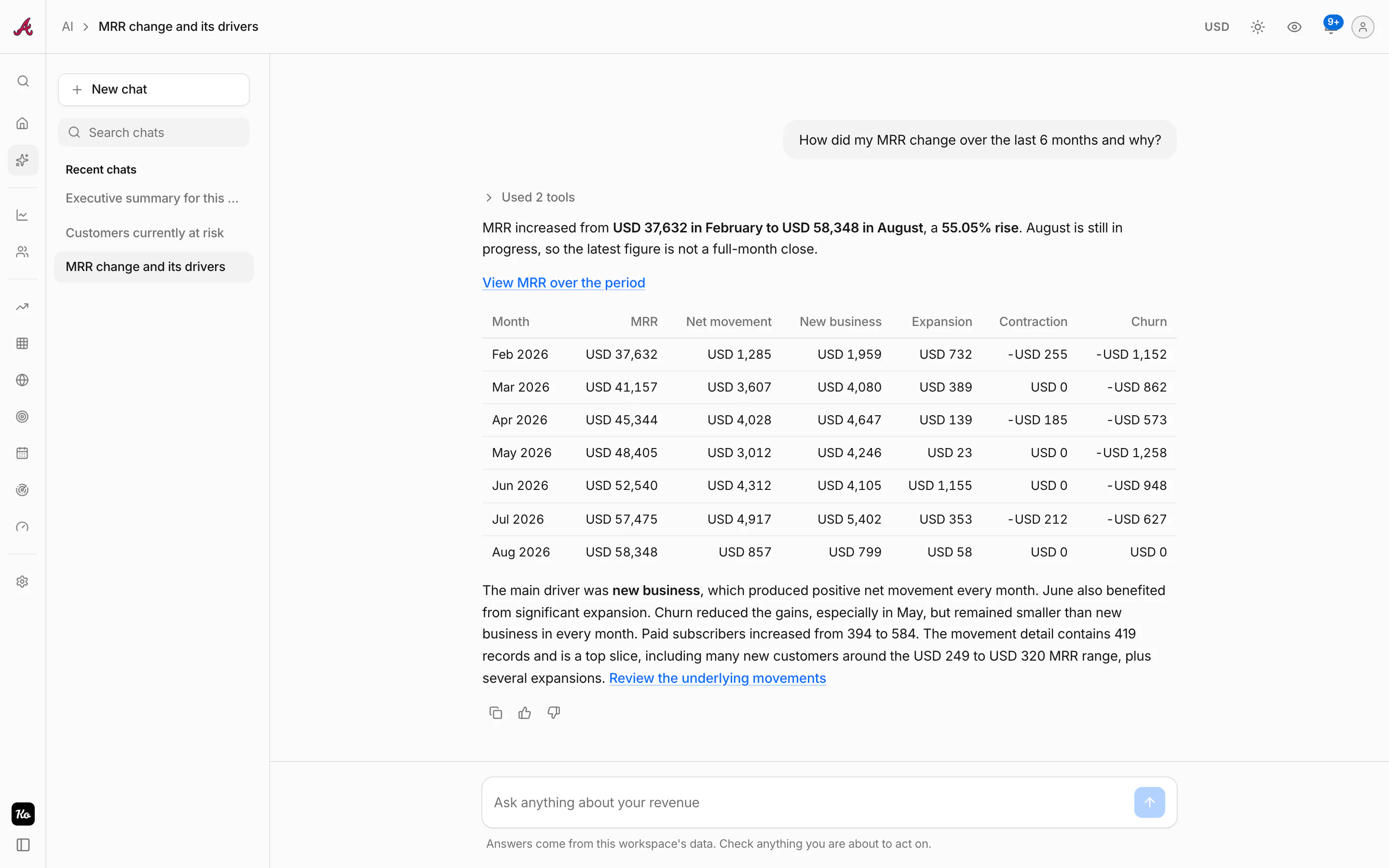
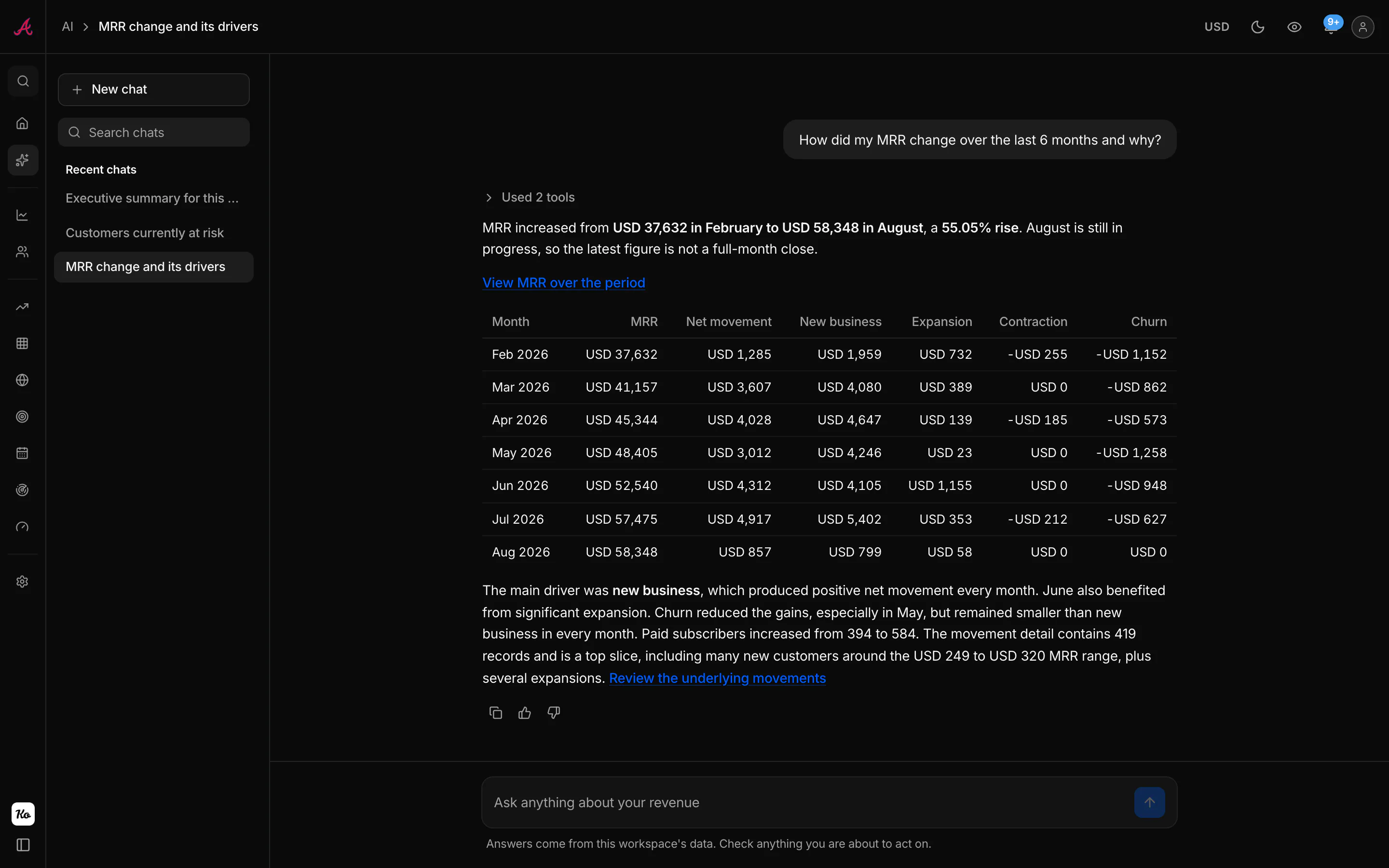
It is on every plan, including the free one. Nothing about the AI is held back for a higher tier, because there is no higher tier.
ChartMogul AI exists too and is also on every plan. If AI in the dashboard is the only thing you are comparing, the two products are close, and I would not switch for it alone.
The ledger under every answer
Here is the thing nobody says loudly enough: an assistant on top of badly modeled billing data does not produce a slightly worse answer. It produces a confident wrong one, in fluent English, with no visible seams.
ChartMogul makes this argument themselves and they are right about it. It is also the reason Kometrics is not a chat interface with a database behind it.
Kometrics imports your whole billing history and rebuilds it as a movement ledger: new business, expansion, contraction, churn and reactivation, one row per event. Every metric on every screen, in every API response and in every MCP tool result is computed from that ledger.
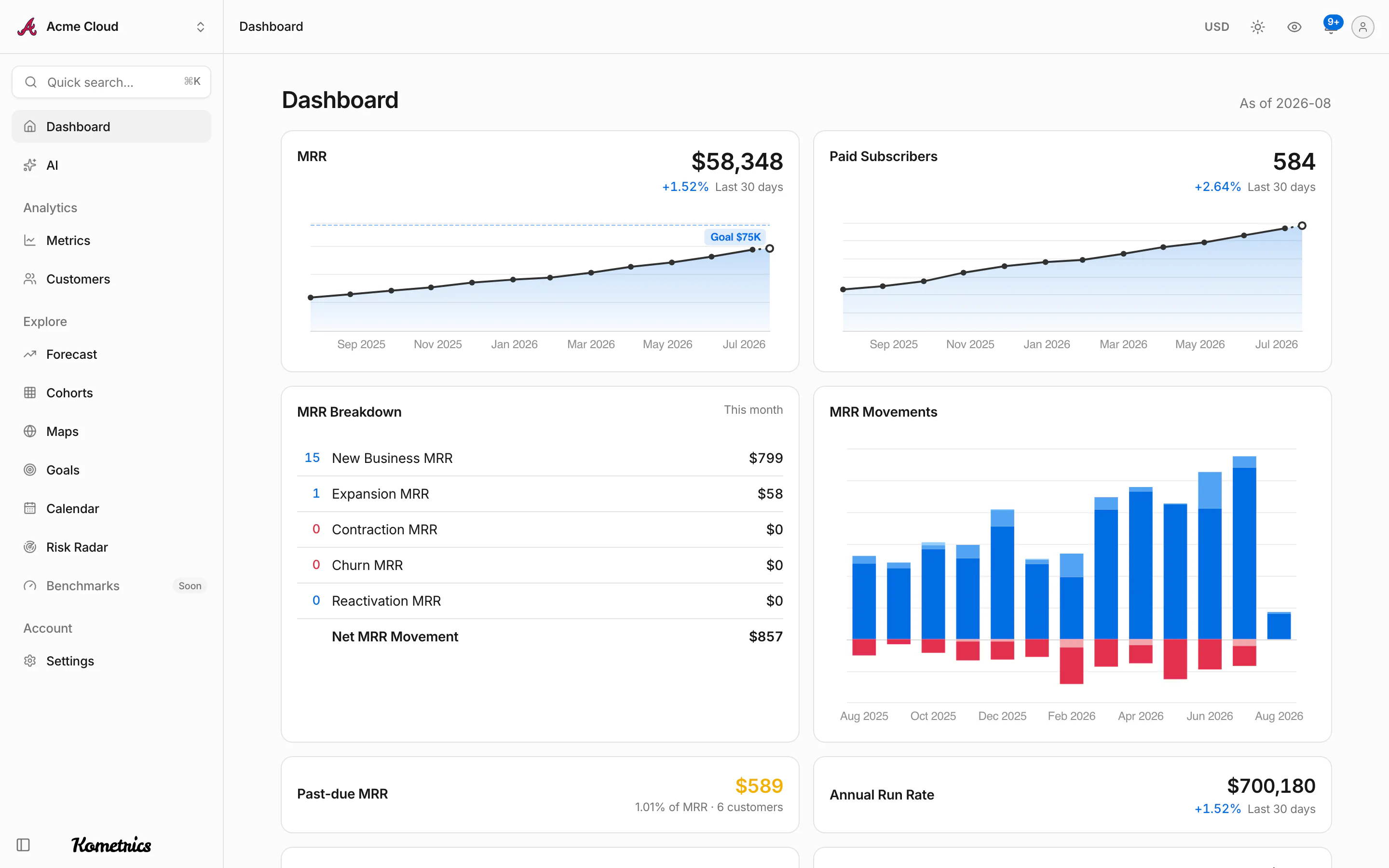
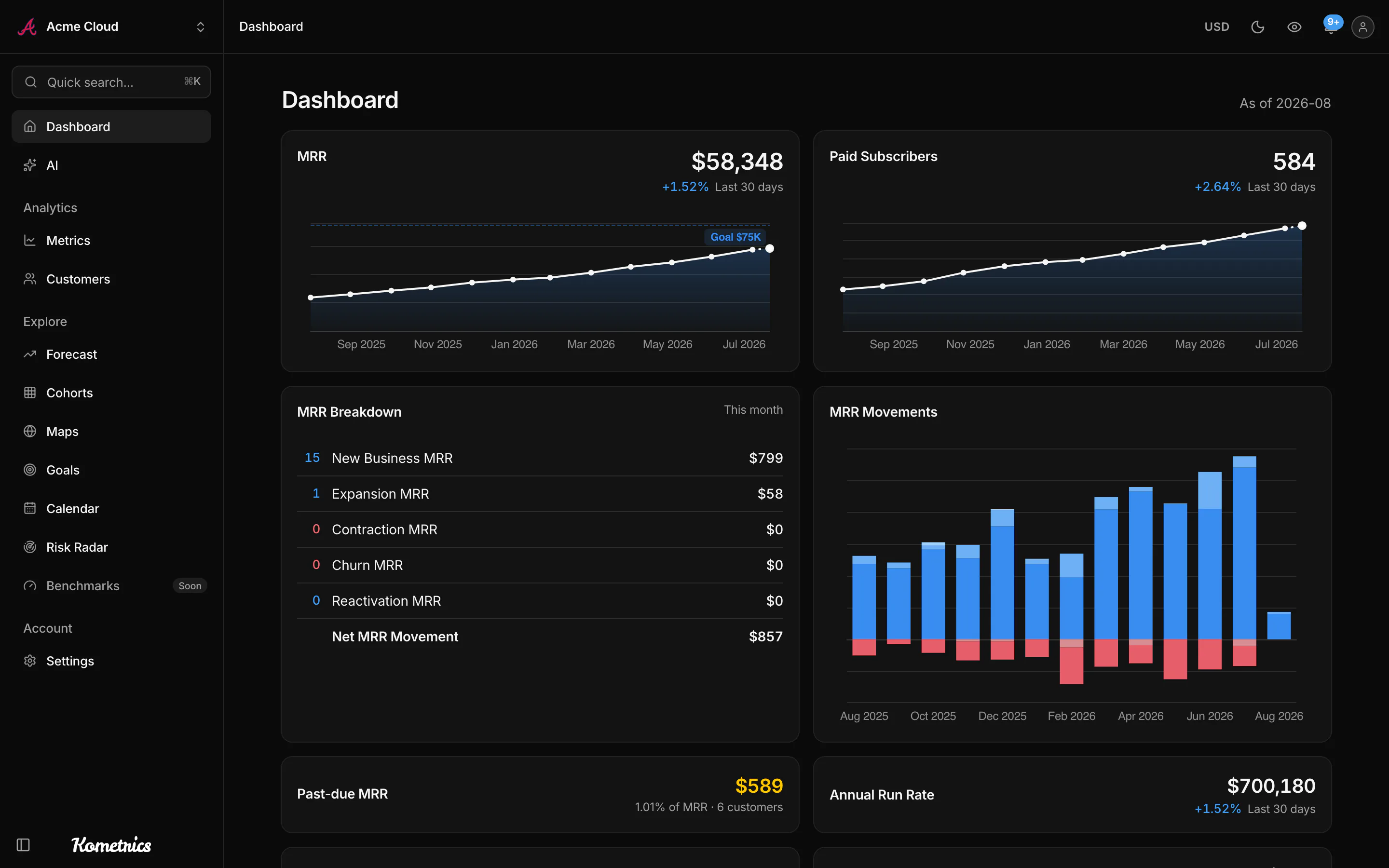
Which means any number an agent gives you can be opened up until you are looking at the invoices behind it. Not "the model said $58,348", but a figure with a path back to the events that produced it.
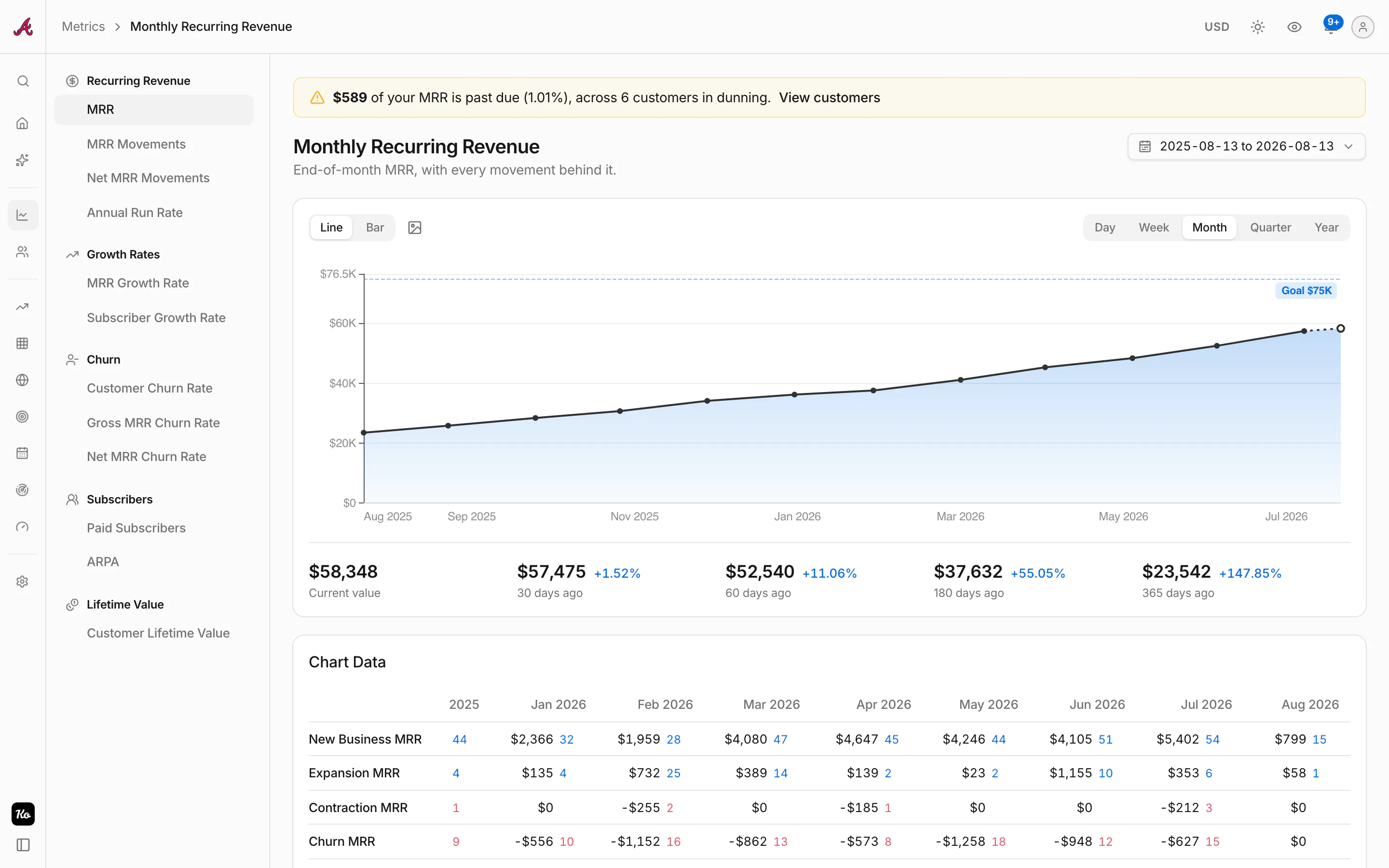
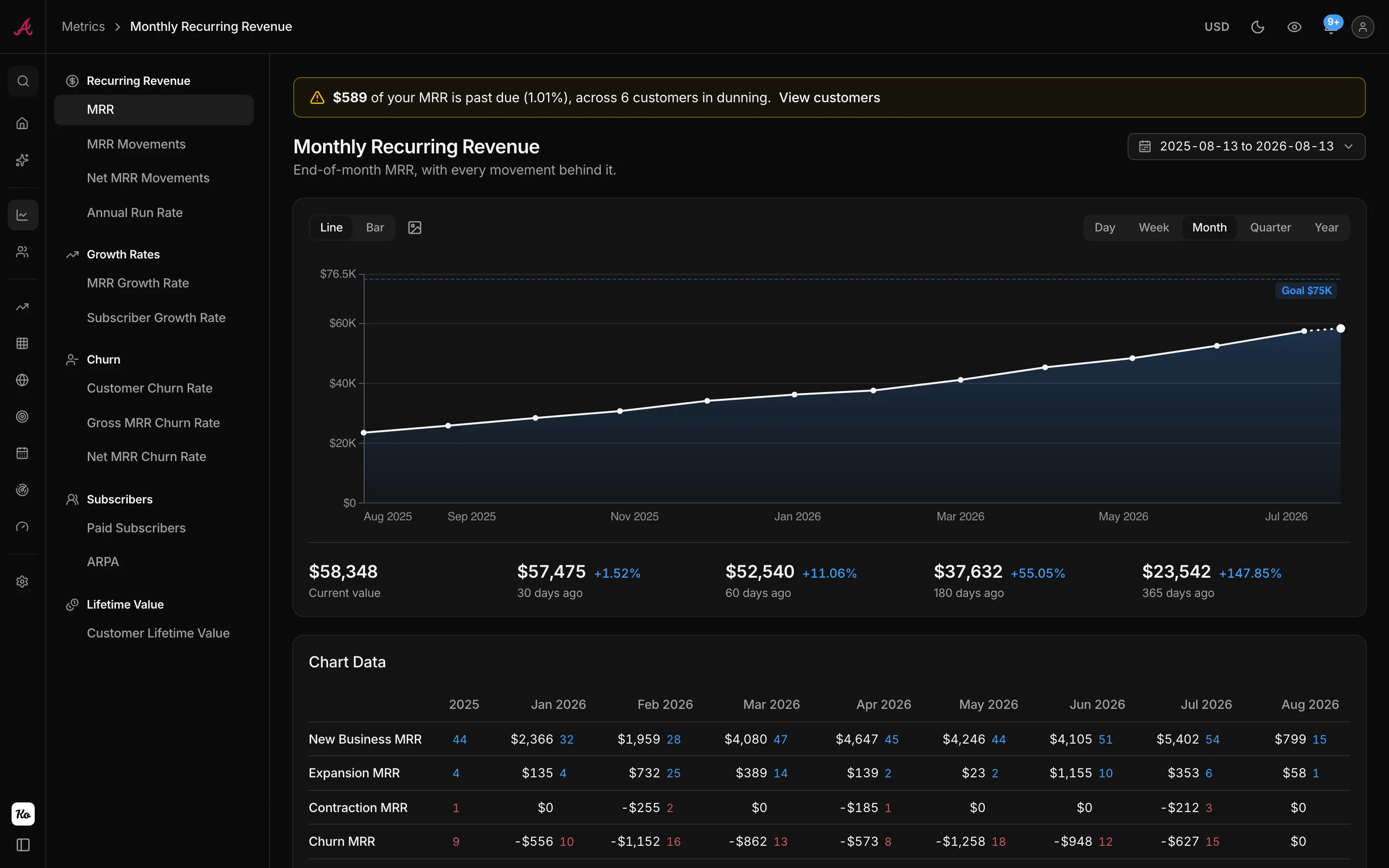
If you want the long version of why this is harder than it sounds, we wrote what MRR actually is and it goes through the edge cases one at a time.
Where we are genuinely behind: we read Stripe, Paddle, Creem and Asaas, and that is it. If you bill through Zuora, Recurly, Chargebee or Braintree, we cannot read your data today. Tiered and metered prices are not supported either, and rather than guess at them we skip them and tell you we skipped them. ChartMogul models usage-based billing properly, and a decade of edge cases is a real advantage that no amount of AI positioning cancels out.
Built to be read by machines
The MCP server is the visible part. The rest of the product is built the same way.
The API is on its own host. https://api.kometrics.com/v1, keys and JSON, no session and
no cookies. Full access and webhooks at the base price rather than gated behind an
enterprise tier, and the OpenAPI document is at
https://api.kometrics.com/v1/openapi.json if you would rather generate a client than read
docs.
And the migration story here is unusually good. ChartMogul's API authenticates with HTTP
Basic using the key as the username. So does ours. The metrics endpoint has the same name,
the same date parameters, the same interval values, and returns the same entries envelope.
# ChartMogul
curl -G -u YOUR_CHARTMOGUL_KEY: \
  https://api.chartmogul.com/v1/metrics/all \
  -d start-date=2026-01-01 -d end-date=2026-08-31 -d interval=month

# Kometrics
curl -G -u ko_YOUR_KOMETRICS_KEY: \
  https://api.kometrics.com/v1/metrics/all \
  -d start-date=2026-01-01 -d end-date=2026-08-31 -d interval=month
For a lot of scripts that is the whole migration: change the hostname and the key. The response fields are not identical, so read the differences before you assume it is free:
| ChartMogul | Kometrics |
|---|---|
mrr, arr, customers, arpa, ltv | Same names, same USD cents |
mrr-percentage-change | mrr-growth-rate |
mrr-churn-rate | gross-mrr-churn-rate and net-mrr-churn-rate, separately |
asp | Not returned |
| Movements need a second call | mrr-new-business, mrr-expansion, mrr-contraction, mrr-churn, mrr-reactivation arrive in the same row |
Even the marketing site is machine readable. Every page has a plain markdown twin: append
.md to any URL, or send Accept: text/markdown. There is an
llms.txt index of the whole site, and a fuller dump at
llms-full.txt. If you ask an assistant what Kometrics does, it does not have to scrape a
React app to find out.
None of this is a feature anyone asks for by name. It is just what a product looks like when you assume from the start that half its readers are not people.
What else is on the plan
There is only one plan, so nothing is held back for a higher one. Forecast, Cohorts, Risk Radar, Revenue Calendar, Goals and Maps are all included, on the free tier too.
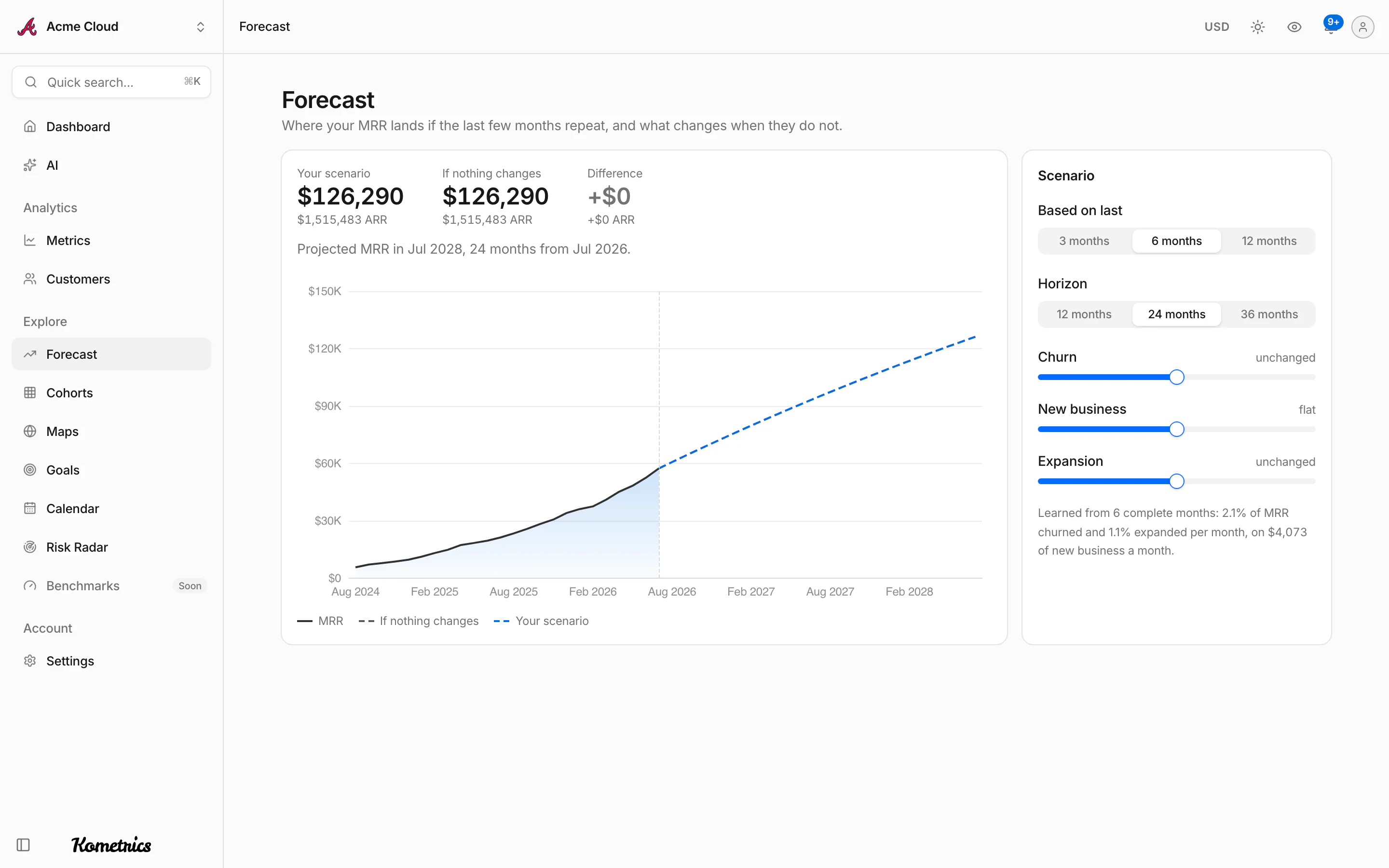
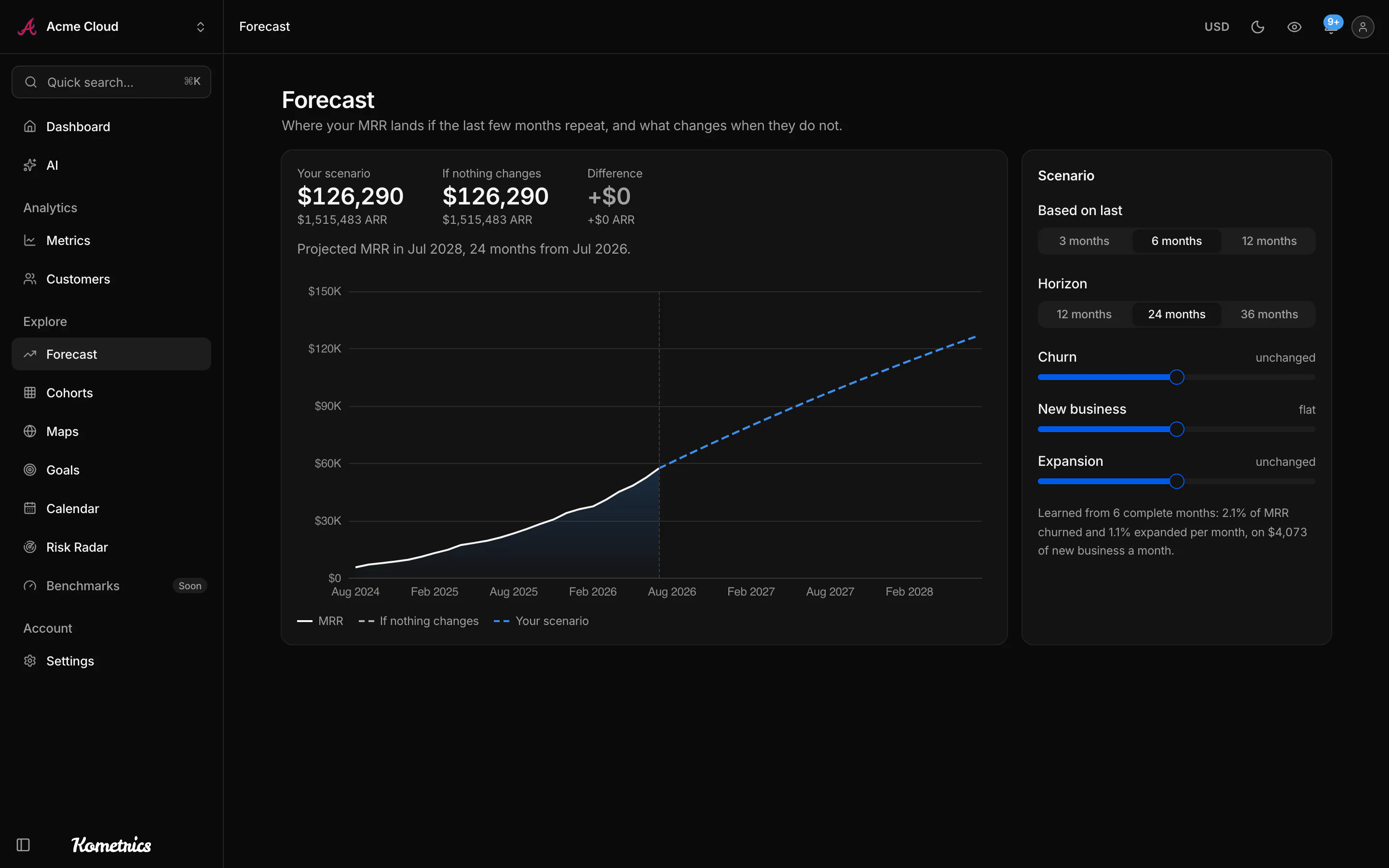
Forecast projects the book forward from your own movement history, with sliders for churn, new business and expansion so you can ask what a bad quarter looks like before you live through one.
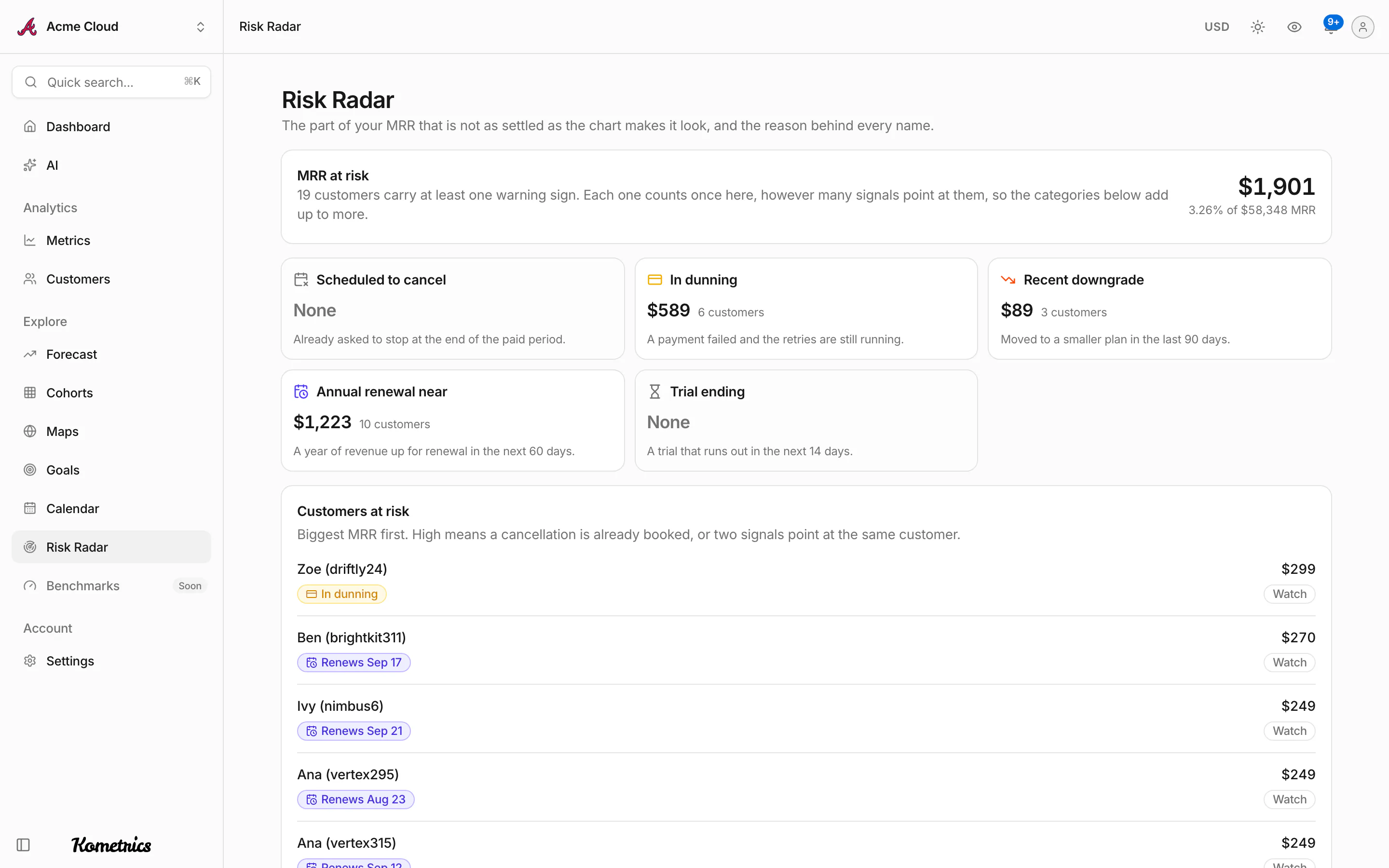
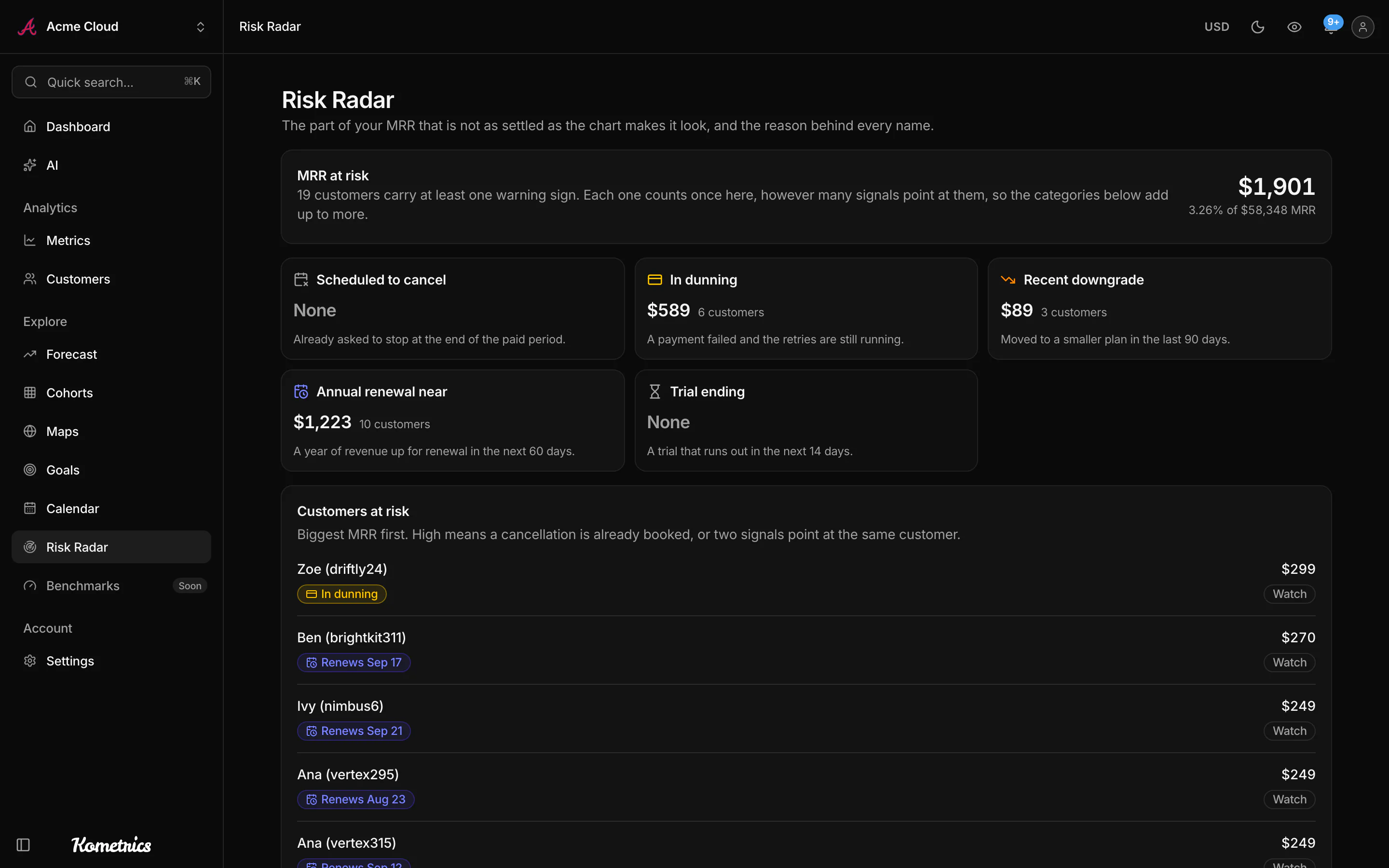
Risk Radar ranks customers by how much recurring revenue is actually at risk, using failed payments, usage collapse, plan downgrades and renewal proximity. ChartMogul does not ship an equivalent product; you can get partway there with segmentation.
One gap to be clear about, because it is a real one: Kometrics will show you the MRR sitting on failed payments, but it will not go and collect it. There is no dunning, no card update page, no win-back sequence. If involuntary churn is your actual problem, the honest recommendation is Baremetrics Recover, or Paddle Retain if you already bill through Paddle.
Fair pricing, since you will ask
Kometrics is $19 a month, or $15 billed yearly, and free while your book is under $1,000 MRR. Every report, every tool, the API, the MCP server and unlimited team members are included at that price.
The part worth knowing is not the number, it is what the number follows. ChartMogul prices on the ARR it tracks: seven bands from $0 to $10M, then Enterprise from $19,900 a year. Cross a threshold and the analytics get more expensive without becoming more useful.
| Your book | Kometrics | ChartMogul |
|---|---|---|
| Under $1,000 MRR | Free | Free (under $120K ARR) |
| $10,000 MRR ($120K ARR) | $19/mo | $69 to $119/mo |
| $85,000 MRR ($1M ARR) | $19/mo | $165 to $299/mo |
| $250,000 MRR ($3M ARR) | $19/mo | $295 to $539/mo |
| $580,000 MRR ($7M ARR) | $19/mo | $619 to $1,139/mo |
I am not going to promise the price never moves, because I do not know what this product looks like in three years. What I will say is that it is not indexed to your success, and there is no plan above the one you are on to be pushed toward.
Two honest notes on the other side of this. ChartMogul's free tier is genuinely better than ours: free under $120K ARR, roughly ten times our threshold, with unlimited seats, the CRM, benchmarks and API included. And there is a quirk in their ladder worth planning around, which is that Starter caps you at three seats and removes CRM sources, so the first paid tier can feel like a downgrade from Free.
If free is your only requirement and your book is under $120K ARR, stay on ChartMogul. Come back when the threshold arrives.
When ChartMogul is still the right answer
I would rather you pick correctly than pick us, so here is the list, and it is not a formality.
You bill through more than one system. Consolidating several billing platforms into one book, with the same subscription linked across them, is genuinely hard and ChartMogul does it well. We read four sources and none of them are Zuora, Recurly, Chargebee or Braintree.
You want your agent to reach the CRM too. Pipelines, opportunities tied to the subscription lifecycle, tasks and connected mailboxes are all in their product and exposed to their MCP server. We deliberately do not build a CRM, so an assistant connected to Kometrics can tell you what your revenue did and nothing about your deals.
You want benchmarks. Anonymised data from thousands of SaaS companies, drawn directly on your own charts, is a real board-deck asset. We compare you against your own history and nothing else.
Your billing is usage-based. Tiered and metered pricing is modeled properly there and not at all here.
You need FX separated from real growth. ChartMogul quantifies how much of an MRR move was currency drift rather than expansion. Very few tools do this at all.
You are under $120K ARR and want free. Covered above. Theirs is better.
Procurement needs SOC 2 Type II and a decade of track record. They have both. We are the newest product in the category, and pretending otherwise would be the fastest way to lose your trust.
How to switch, in three steps
The good news about this category is that nobody holds your history hostage. Both tools rebuild everything from the billing system itself, so there is no export to negotiate and no migration project to schedule.
Step 1: Connect your billing
About five minutes. Sign up, open Sources, connect Stripe, Paddle, Creem or Asaas. Kometrics reads the full history back to your first invoice and rebuilds the ledger from it. Nothing is imported from ChartMogul, because nothing needs to be.
How long the first sync takes depends on how many invoices you have. A few thousand is minutes.
Step 2: Check the numbers side by side
An afternoon, and worth it. Do not skip this, and do not take either tool's word for it. Open ChartMogul's MRR chart and ours for the same period and compare month ends.
If they disagree, the usual causes are boring and findable: a data source connected to one tool and not the other, non-USD subscriptions converted at different rates, manual MRR edits that only ever existed inside ChartMogul, or one tool counting a one-off charge the other correctly excludes. Every figure in Kometrics opens down to the invoices behind it, which is what makes this checkable rather than a matter of faith.
Run both in parallel for a month if the stakes are high. It costs $19.
Step 3: Connect your assistant, then cancel
Point Claude, ChatGPT, Claude Code or Codex at the connector before you cancel anything. It takes two minutes and it is the part you are actually switching for, so try it while you still have both. Questions worth asking while the two tools are running side by side:
Then export. Your metrics come back on their own, but anything that only ever existed inside ChartMogul does not travel:
- Manual MRR edits, and their audit trail
- Custom attributes and tags
- CRM records: opportunities, notes, tasks, email history
- Saved segments and custom dashboards
ChartMogul makes the export easy (the API, CSV exports and a raw source data export are on every plan, including Free), but there is a clock: after you cancel, the account deactivates in about 15 days and the data is purged roughly 60 days after that. Do it while the account is live.
Common questions
Is Kometrics better than ChartMogul for AI? For getting answers about your own revenue out of an assistant, I think so: nine question-shaped tools, OAuth on four named clients, and every answer traceable to the invoices behind it. For breadth, no. Their connector reaches CRM, benchmarks and cash flow data that we simply do not have.
Does ChartMogul have an MCP server? Yes, on every plan including Free, and it works well. Anyone telling you this is a Kometrics exclusive is selling you something.
Which AI clients does Kometrics support? Claude, ChatGPT, Claude Code and Codex, each with its own setup page. It is a standard MCP endpoint over OAuth 2.1, so other MCP clients generally work too. Those four are the ones we have walked through end to end and will support when they break.
Can an assistant change my data? No. Every tool the connector exposes is read only. There is no write path to expose, regardless of what you or the model asks for.
Is Kometrics cheaper than ChartMogul? Usually, and the gap widens as you grow, because their price follows your ARR and ours does not. The exception is a book under $120K ARR, where ChartMogul is free and more generous than our free tier.
Do I lose my history if I switch? No. Both tools rebuild metrics from the billing system, so connecting Stripe, Paddle, Creem or Asaas gives you your full history without an export. What does not carry over is data that only ever lived inside ChartMogul: manual MRR edits, custom attributes, and CRM records.
Is ChartMogul more accurate? Both rebuild MRR from billing events rather than estimating it, so neither is guessing. ChartMogul handles more billing edge cases, simply because it has met more of them, particularly around multi-system subscriptions and currency drift. The flip side shows up in their reviews: numbers not reconciling with the source billing system is the most durable complaint theme across a decade of them. Check both against Stripe yourself, which is step 2 above.
What does ChartMogul do that Kometrics does not? Around 31 billing sources against our four, a full CRM, industry benchmarks, usage-based billing, currency fluctuation analysis, an Android app, and SOC 2 Type II.
Can I try it without connecting my real billing data? Yes. The demo is a full workspace with three years of history behind it, so you can click through every report before deciding whether to point anything at production.
Who wrote this and should I trust it? I did, and I sell one of the two products in it, so weigh it accordingly. What I can promise is that nothing here is hidden: ChartMogul's free tier is better than ours, their integration catalog is eight times the size, their connector reaches data ours cannot, and there are six situations listed above where they are the right purchase. The head to head comparison has the full feature grid, and we do the same exercise against Baremetrics and ProfitWell if they are on your list too.
The fastest way to settle it is to connect Stripe, connect your assistant, and ask it why your MRR moved last month. That takes about ten minutes and costs nothing under $1,000 MRR.
Know your revenue. Trust the metrics.
Connect Stripe and get every SaaS metric computed from your real billing history. Free under $1,000 MRR.
Start freeKeep reading

Gross churn vs net churn: the leak, and what covers it
Gross MRR churn measures what you lost; net churn subtracts the expansion that covered it. Formulas, a worked example, negative churn, and why quoting only one of them misleads.

Paddle vs Stripe for SaaS: merchant of record or payments platform
Paddle and Stripe are different species: one becomes the seller and handles global tax for 5% + 50¢, the other gives you the best payments infrastructure and leaves compliance to you. The real comparison, with the math.

Bookings vs revenue: what you sold, what you earned, and what hit the bank
Bookings measure commitments, revenue measures delivery, and cash measures timing. The differences explained with one annual contract, plus where MRR and ARR fit in the picture.