

Paddle vs Stripe for SaaS: merchant of record or payments platform
Paddle and Stripe are different species: one becomes the seller and handles global tax for 5% + 50¢, the other gives you the best payments infrastructure and leaves compliance to you. The real comparison, with the math.
By Pedro Campos

Paddle vs Stripe reads like a pricing comparison, and the pricing is the least interesting part. The two products occupy different legal positions in your business: Stripe processes payments for you, while Paddle becomes the seller, with everything that implies about tax, compliance and control. Most of the internet compares their fees; the fees only make sense after the structural difference is clear, so that is where this starts.
Disclosure of our seat in this: Kometrics reads billing data from both (and from Creem and Asaas), so we have no side. The metrics angle comes at the end.
The structural difference: who is the seller
Stripe is a payment service provider. The customer buys from you. Stripe moves the money, and everything that surrounds the sale (registering for VAT in the EU, collecting the right sales tax in Texas, filing, remitting, absorbing chargebacks) is legally your problem, with Stripe products available to help with slices of it.
Paddle is a merchant of record. The customer buys from Paddle, which resells your software. The line on the buyer's card statement is Paddle's, the tax obligation is Paddle's, the registrations and filings in however many countries are Paddle's, and Paddle then pays you out. You gain freedom from an entire category of compliance; you give up being the seller, with the control and the direct banking relationship that entails.
Everything downstream in this comparison is that one difference wearing different costumes.
The pricing, and the math behind it
| Stripe | Paddle | |
|---|---|---|
| Headline rate | From 2.9% + 30¢ per card charge (US; varies by country) | 5% + 50¢ per transaction, worldwide |
| Recurring billing | +0.7% of Billing volume | Included |
| Sales tax and VAT | Stripe Tax as a paid add-on; registration and filing stay yours | Included: registration, filing, remittance are Paddle's |
| International cards and FX | Surcharges apply | Included |
| Dunning and recovery | Built-in basics, configurable | Included, with Retain as the paid upgrade |
| Chargeback liability | Yours | Paddle's |
Read as a number, 5% against 2.9% looks like Paddle costing 70% more. Read as a stack, the gap narrows fast: add Billing's 0.7%, Stripe Tax, international surcharges, and the accountant hours spent on quarterly VAT filings in jurisdictions you sell into, and a global-selling SaaS often lands within sight of Paddle's all-in rate. A US-only SaaS selling to US customers does not; for them, Stripe's math wins cleanly, because the compliance Paddle bundles is compliance they barely have.
The honest summary: Paddle's 5% is a price for not having an international tax problem. Whether that is expensive depends entirely on whether you have one.
What Stripe buys you
- Control and surface area. The best payments API in the industry, usage-based billing, Connect, Terminal, an ecosystem where every tool integrates with you first, and an MCP server your AI agents can already use.
- Your own merchant identity. Your name on statements, your banking relationships, your negotiated rates at scale.
- No ceiling. Whatever billing model you invent, Stripe can express it. MoR catalogs are narrower by nature.
What Paddle buys you
- The tax problem, gone. EU VAT, UK VAT, US state sales tax across economic-nexus thresholds: registered, collected, filed, remitted, by someone else, with liability sitting there too.
- One integration for a global price. FX, local payment methods and international cards without surcharge arithmetic.
- Less operational surface. Chargebacks, billing support email, recovery: bundled. For a one-founder SaaS selling worldwide, this is often the difference between doing compliance badly and not doing it at all.
Choosing, without the hedging
Choose Stripe if your revenue is mostly US or single-country, you want usage-based or otherwise exotic pricing, you are building on the ecosystem (or on Connect), or you are big enough that negotiated rates and owning the merchant relationship pay for a finance team's attention.
Choose Paddle if you sell software globally with a small team, VAT registrations are the thing keeping you up at night, and a predictable all-in rate beats a lower headline number with six asterisks.
Both are good products. The wrong choice is usually not picking the loser; it is a US-only SaaS paying the MoR premium for compliance it does not need, or a two-person team selling into 40 countries pretending the tax problem does not exist because Stripe's rate looked better.
The metrics do not care which one you pick
Whichever side you land on, the analytics question is identical: normalized MRR, movements, churn, cohorts and LTV, computed the same way regardless of who processes the payment. That is the layer Kometrics provides on top of either choice: connect Stripe or Paddle (or both, or Creem or Asaas) and the movement ledger is rebuilt from the billing history, with every customer's source visible beside their numbers:
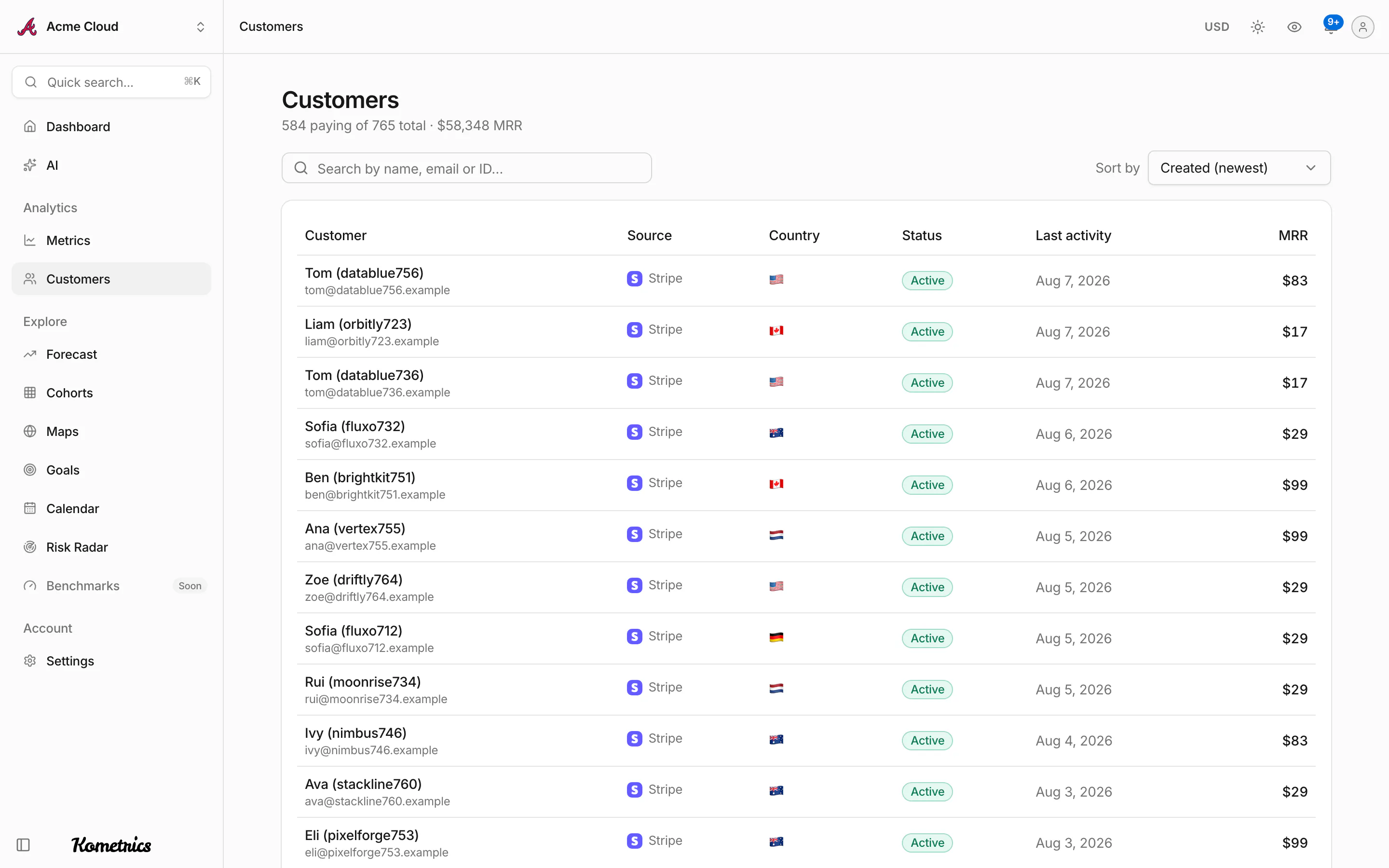
The practical consequence is that the biller stops being a lock-in decision for your metrics: switch processors and your MRR history stays one continuous series, because it was never derived from any one provider's dashboard. Free under $1,000 MRR.
FAQ
Is Paddle cheaper than Stripe?
On headline rate, no: 5% + 50¢ against Stripe's from 2.9% + 30¢. On total cost for a SaaS selling globally, sometimes yes, once Billing (0.7%), Stripe Tax, international surcharges and the compliance hours are added. US-only sellers almost always come out ahead on Stripe.
Is Paddle a payment processor?
It is more than one: as merchant of record, Paddle is legally the seller of your product, which is why it can absorb tax obligations and chargeback liability that a pure processor cannot.
Can I use Stripe and Paddle at the same time?
Yes, and companies do (for example, US direct sales on Stripe, international on Paddle). Your metrics layer has to consolidate the two books into one ledger; Kometrics reads both sources into the same workspace.
Can I migrate from Stripe to Paddle, or back?
Yes, but card credentials do not travel the same way they do between processors, because the merchant of record changes. Plan a migration of subscriptions at renewal, and keep your metrics history intact by computing it outside either biller.
Know your revenue. Trust the metrics.
Connect Stripe and get every SaaS metric computed from your real billing history. Free under $1,000 MRR.
Start freeKeep reading

Bookings vs revenue: what you sold, what you earned, and what hit the bank
Bookings measure commitments, revenue measures delivery, and cash measures timing. The differences explained with one annual contract, plus where MRR and ARR fit in the picture.

Involuntary churn: the revenue you lose to failed payments, and how to get it back
A meaningful share of SaaS churn is cards failing, not customers leaving. What involuntary churn is, the free dunning fixes to configure first, how to measure your past-due exposure, and when paid recovery tools earn their fee.

Stripe Sigma explained: what it does, what MRR costs in SQL, and when you need it
Stripe Sigma is SQL over your Stripe data, right in the dashboard. What it is great at, what its own MRR template really involves, and how to decide between Sigma, a warehouse, and a subscription analytics tool.