

How to connect Stripe to Claude (and actually ask about your revenue)
Two ways to connect Stripe to Claude over MCP: the official Stripe server for payment operations, and Kometrics for MRR, churn and LTV your agent can reason over. Setup for Claude, Claude Code and Codex.
By Pedro Campos

Once Claude can see your Stripe account, a category of busywork disappears. Refunds happen in a sentence. "Who paid us today" stops requiring a dashboard login. Your monthly investor update pulls its own numbers. This guide is the whole setup, end to end, in about ten minutes.
One thing most guides skip: there are two different connections hiding behind "connect Stripe to Claude", and which one you want depends on the question you plan to ask.
| Route A: Stripe MCP server | Route B: Kometrics connector | |
|---|---|---|
| What Claude gets | Raw Stripe API access | Computed subscription metrics |
| Best at | Doing things: refunds, links, invoices | Explaining things: MRR, churn, cohorts, LTV |
| Can it write? | Yes (refunds, cancellations, edits) | No, read only by construction |
| Auth | OAuth (or restricted key) | OAuth, no key to paste |
Most SaaS founders end up wanting both, and they do not conflict. Set them up in either order.
Route A: the official Stripe MCP server
Stripe hosts a remote MCP server at https://mcp.stripe.com. Nothing to install or deploy;
you add the URL to your client and approve an OAuth screen:
One line adds it. Then run /mcp and authenticate with OAuth in the browser.
claude mcp add --transport http stripe https://mcp.stripe.com/Desktop or web, on any paid plan.
- 1Open Settings, then Connectors, then Add custom connector.
- 2Paste https://mcp.stripe.com as the URL and save.
- 3Approve the OAuth consent screen Stripe opens, choosing the account it may read.
ChatGPT installs Stripe as a plugin rather than by URL. Plus, Pro, Business, Enterprise and Education plans.
- 1Open the plugin store and install the official Stripe plugin.
- 2Approve the OAuth consent screen Stripe opens, choosing the account it may read.
- 3Ask something ("list my open disputes") to confirm the tools respond.
Add this to ~/.cursor/mcp.json, then approve the OAuth prompt.
{
  "mcpServers": {
    "stripe": {
      "url": "https://mcp.stripe.com"
    }
  }
}
Add the server to ~/.codex/config.toml, then sign in with the second line.
[mcp_servers.stripe]
url = "https://mcp.stripe.com"

# then, in the terminal:
codex mcp login stripe
Once connected, Claude can search the Stripe API, read your account data, and act on it. Prompts that earn their keep immediately:
Two cautions before you hand it live-mode access. First, this server writes: it can refund charges, cancel subscriptions and void invoices, so keep Claude's tool confirmation on and review what it proposes before approving. Second, if a workflow only ever reads, connect it with a restricted API key that has no write permissions instead of OAuth. We went deep on the tool list and the security model in the Stripe MCP server, explained.
Route B: your metrics, computed before Claude asks
Here is the wall you will hit with Route A: ask "what was my MRR growth last month, split by new business, expansion, contraction and churn" and Claude has to page through raw subscription objects and do the math itself. MRR is not a field in the Stripe API; it is a computation full of judgment calls (annual plans, proration, trials, coupons, past-due accounts), and a model improvising that computation in-context produces a different wrong number every time you ask.
The fix is to put a metrics layer between Stripe and Claude. Kometrics syncs your billing data and normalizes it into a movement ledger: every dollar of new business, expansion, contraction, churn and reactivation, per customer, per month. Claude then reads finished metrics over MCP instead of computing its own.
The setup has two halves. First, Stripe into Kometrics:
- Create a workspace (free under $1,000 MRR, no card).
- Open Settings, then Sources, and pick Stripe from the tile.
- Connect with one-click OAuth, or paste a restricted read key and add the webhook shown.
- The sync runs, and your MRR, movements and customer history appear in a couple of minutes.
Then Kometrics into Claude:
Then run /mcp and choose Authenticate: the browser opens once for the approval screen, where you pick the workspace.
claude mcp add --transport http kometrics https://app.kometrics.com/mcpDesktop or web. The connector URL is https://app.kometrics.com/mcp.
- 1Open Settings, then Connectors, then Add custom connector.
- 2Paste the connector URL and save.
- 3Approve it on the Kometrics screen, choosing the workspace it reads.
The connector URL is https://app.kometrics.com/mcp, with OAuth as the authentication.
- 1Turn on Developer mode under Settings, then Connectors.
- 2Add a connector with the connector URL, and OAuth as the authentication.
- 3Approve it on the Kometrics screen, choosing the workspace it reads.
The second line opens the browser for the approval screen.
codex mcp add kometrics --url https://app.kometrics.com/mcp
codex mcp login kometrics
There is no API key in this half at all: Claude registers itself over OAuth, you approve it on a Kometrics screen, and you pick which workspace it may read there. Every tool it gets is read only, so this connector never needs to appear in your "what can my agents break" threat model.
What asking actually looks like
That per-customer, per-movement specificity is the point of Route B. The number Claude cites is the same one the dashboard renders, computed once from the ledger, so you can click through and verify rather than trust:
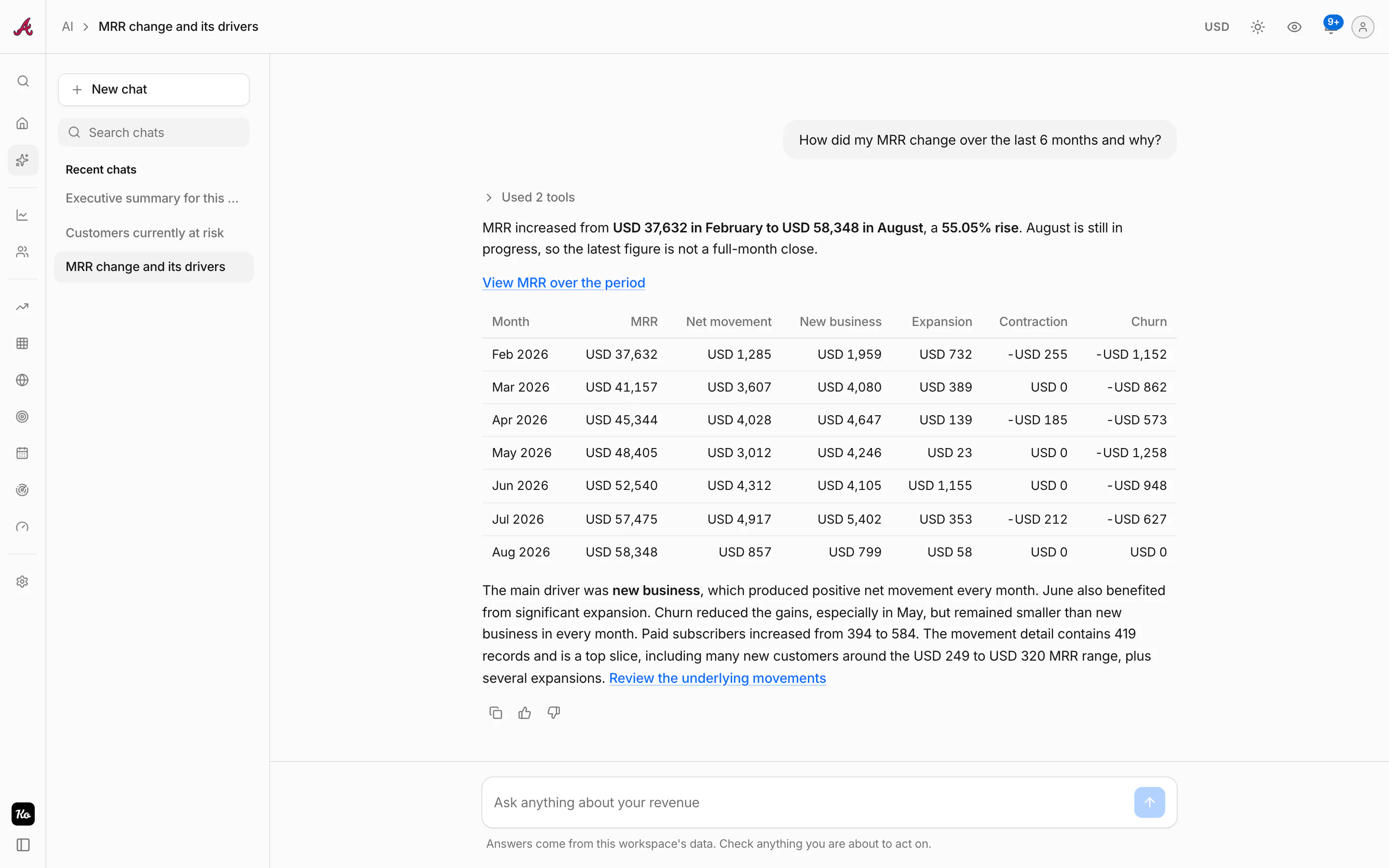
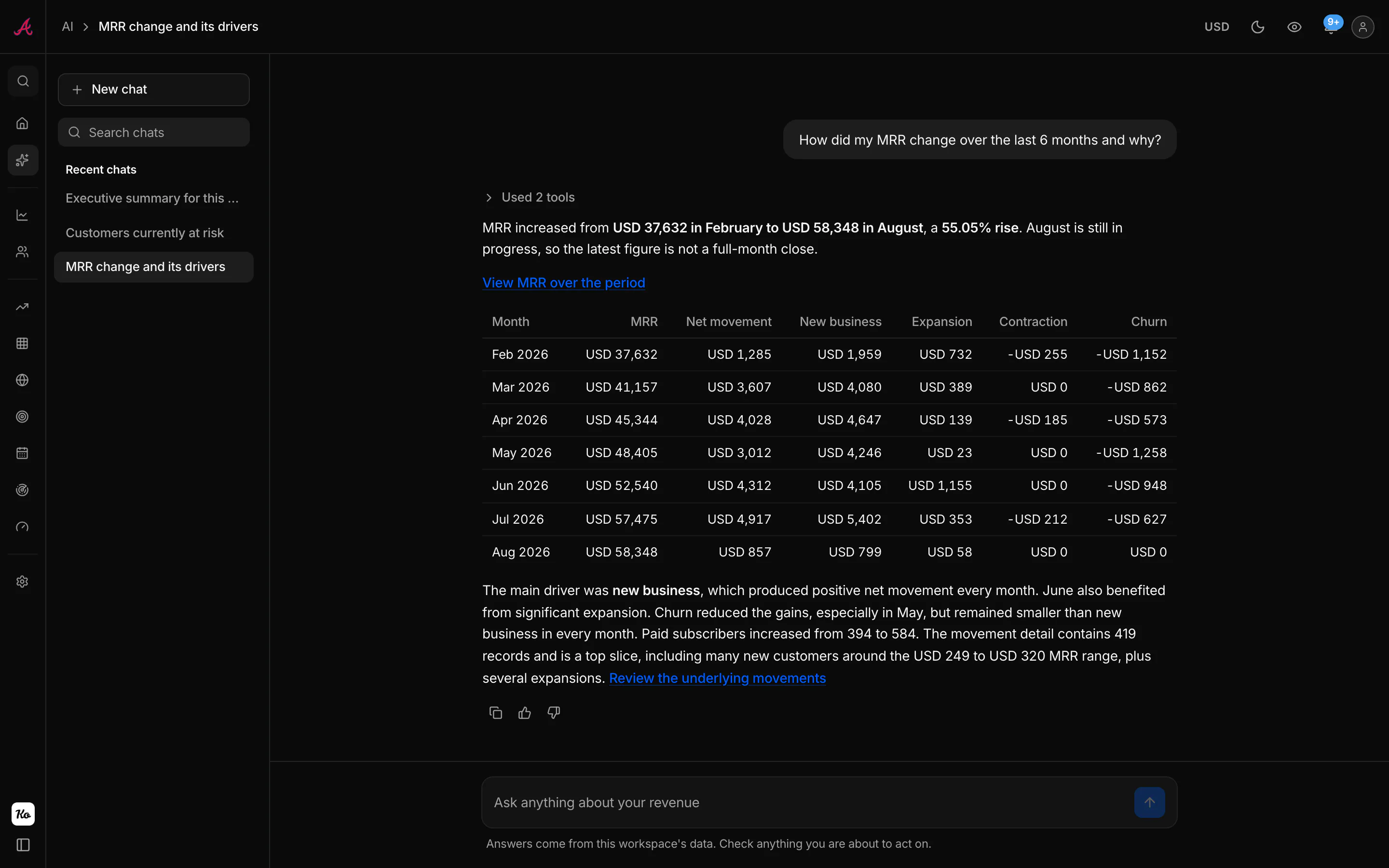
Prompts to start with once you are connected:
Which route do you need?
- You mostly operate: refunds, payment links, invoice chasing, support lookups. Route A alone covers you.
- You mostly ask: growth, churn, cohorts, board numbers. Route B alone covers you, and it also reads Paddle, Creem and Asaas if Stripe is not your only biller.
- You are a founder: realistically both, one conversation. "Why did MRR dip, and pause the subscription of whoever disputed that charge" uses each connector for its half.
FAQ
Can Claude connect to Stripe directly?
Yes. Stripe hosts an official MCP server at https://mcp.stripe.com that Claude, Claude Code,
Cursor and Codex connect to over OAuth. No third-party bridge is needed for raw account access.
Is it safe to give Claude access to Stripe?
OAuth-based connections are revocable in your Stripe user settings, and MCP access can be managed account-wide by administrators. The real risk to manage is write access: keep tool confirmation on, or use a read-only restricted key. A metrics connector like Kometrics is read only by construction, so it carries no write risk at all.
Does this work on the free Claude plan?
Custom connectors (both routes here) require a paid Claude plan. Claude Code and the Codex CLI follow their own product's plans.
Can Claude calculate my MRR from Stripe?
It will try, and it will be subtly wrong: annual normalization, proration, trials, coupons and past-due handling each need a consistent policy applied across your whole history. That is what a subscription analytics layer is for; What is MRR? walks through exactly where naive computations break.
Know your revenue. Trust the metrics.
Connect Stripe and get every SaaS metric computed from your real billing history. Free under $1,000 MRR.
Start freeKeep reading

Gross churn vs net churn: the leak, and what covers it
Gross MRR churn measures what you lost; net churn subtracts the expansion that covered it. Formulas, a worked example, negative churn, and why quoting only one of them misleads.

Paddle vs Stripe for SaaS: merchant of record or payments platform
Paddle and Stripe are different species: one becomes the seller and handles global tax for 5% + 50¢, the other gives you the best payments infrastructure and leaves compliance to you. The real comparison, with the math.

Bookings vs revenue: what you sold, what you earned, and what hit the bank
Bookings measure commitments, revenue measures delivery, and cash measures timing. The differences explained with one annual contract, plus where MRR and ARR fit in the picture.